
Sources for Lewis County Former Owners
The Recorder's office is the place to begin. Lewis County publishes no online grantor-grantee portal, so recent deed records must come from the Clerk, Auditor, and Recorder at the courthouse, by phone, or through the county public-record request form. Older collections add depth. They never replace the current custodian for the latest recorded conveyance.
| Ownership source | Verified span | Access route | Historical use |
|---|---|---|---|
| Current recorder instruments | Current cutoff not published | Recorder counter or request | Grantor, grantee, legal description, prior reference |
| Deeds and index catalog title | 1868–1911 | FamilySearch lead and county originals | Early conveyances and name index |
| Probate estate registers | 1911–1940 | FamilySearch and courthouse originals | Death-transfer and heir clues |
| Homestead declarations | 1895–1964 | Recorder and FamilySearch lead | Claim and property-history context |
| Plats and surveys | Varies | Recorder and possible archives route | Lot, block, addition, and boundary history |
Let the chain tell you where to look. The current Recorder covers the years within living memory. When references reach into the 1868–1911 title, switch to those older books. Probate registers matter most when an estate or a personal representative breaks a clean sale-to-sale sequence.
Start With the Latest Conveyance
Open the Lewis County parcel viewer and find the parcel. Jot down the full PARCEL_ID. Note the displayed owner, the address or description, the acreage, and the taxing districts. The owner field is DisplayNam. Treat it as a tax-reference lead only. The county publishes no update lag after a closing.
Next, send the parcel ID, the present owner's exact spelling, a legal-description lead, and a date range to the Recorder. Request the latest conveyance plus any prior instrument it cites. Warranty, quitclaim, personal representative, trustee, sheriff, and tax deeds each push the chain down a different path.
Name Variants in Lewis Owner Records
One person can hide behind several index forms. Search a surname with the full given name, then again with initials, a middle name, or a former surname when the documents support those versions. For an entity, test punctuation-free spellings and suffix variants such as LLC, Inc., partnership, trust, trustee, estate, personal representative, executor, or administrator. Keep the spelling exactly as each instrument shows it. Silent standardizing corrupts a chain. Trusts raise their own puzzles. The instrument may name the trust, the trustee, or both. An estate may appear under the decedent or the representative. Joint tenancy, a life estate, and a remainder interest can crowd several names into one deed while the compact tax popup shows only a single display name. Read the vesting language carefully, along with later releases or orders, before assigning one former owner to that interval. A mailing address is a clue, not a verdict. It may point to an out-of-county owner, a tax agent, a lender, or a post office box, and it never proves anyone occupied the Lewis County property. The situs address locates the parcel. The deed's legal description controls the land conveyed.
Lewis County Owner Chain Timeline
Build one row per verified transfer. Resist the urge to fill a gap with an assessor name or a newspaper mention. Every row should rest on a recorded instrument or a clearly labeled index entry.
| Transfer date | Grantor to grantee | Deed form | Book, page, or instrument |
|---|---|---|---|
| Latest recording | Former owner to current owner | Copy as recorded | Copy exact reference |
| Prior recording | Earlier owner to former owner | Copy as recorded | Follow cited prior reference |
| Earlier book entry | Repeat backward | Note estate or forced-sale form | Preserve book and page |
Execution and recording dates can differ, so copy both. Keep the legal description beside the timeline so similar names or nearby tracts never merge into one history.
Walk the Lewis Deed Chain Backward
The current deed names the party who conveyed the parcel. That grantor becomes the next former owner to trace. Search the name as a grantee in the earlier period, using the legal description and any prior-instrument reference to control the match.
- Request the current owner's acquiring deed, with that owner shown as grantee.
- Read the grantor, legal description, recording date, and cited prior instrument.
- Search the grantor as an earlier grantee, allowing initials, punctuation, trust, estate, and entity variants.
- Repeat until the accessible index ends, then continue through deed books, cataloged images, or an office request.
- Grantor / grantee
- The conveying party and receiving party named in a deed.
- Chain of title
- The ordered series of instruments connecting ownership through time.
- Reverse index
- An index arranged by grantor, useful for tracking what an owner conveyed.
- Warranty / quitclaim deed
- Different conveyance forms whose effect must be read in the actual instrument.
Lewis County Index Cutoff Is Unpublished
Lewis County publishes no current online deed-index start year. The Auditor page offers office information and a public-record request form instead. A CSC bulletin confirms electronic recording for submitters. E-recording is a filing channel, though, not a public image search.
Historic lead. FamilySearch identifies “Deeds, 1868–1911; Index, 1868–1911,” though image access and availability must be checked.
The title predates Lewis County's 1911 organization, so territorial or predecessor-county context may matter. Ask the Recorder or Idaho State Archives how each book is labeled. Also ask whether the usable copy is an original, a microfilm reel, or a digital image.
Local Names Reveal Previous Owners
Craigmont deeds and notices may use Ilo or Vollmer, since those towns consolidated in 1920. Later street-vacation ordinances touched named roads, alleys, additions, Prairie Avenue, and Block 30. Search the modern parcel first, then the old town, addition, block, and ordinance number. Nezperce records may say Nez Perce. City code names Mowry's, Lux, Johnson's, Nezperce S, and Scale House. Test apostrophe-free forms too. Kamiah searches may require a county check. Postal and community geography can cross county lines. Place-name repairs help. They never replace grantor and grantee research.
Estates Interrupt Former Owner Chains
A former owner may vanish from the next ordinary deed. That happens when land moves through probate. It can also pass through a personal representative, a trust, a sheriff sale, a tax deed, or a court order. Lewis County probate estate registers run from 1911 through 1940. They offer a historic bridge across those gaps. Current property cases may require the Idaho iCourt index first, then the actual clerk file. Record the decedent, the representative, and any heirs named in the instrument. Note the case number, the deed type, and the legal description too. A probate docket can explain who had authority. Still, one document belongs in the final ownership timeline. That is the recorded deed or decree affecting title.
Deed Terms for Former Owner Requests
Not every change of ownership arrives as a simple warranty deed. So give the Recorder precise vocabulary. Lewis County books hold quitclaim deeds, trustee's deeds, personal representative and administrator deeds. They also hold sheriff's deeds, and tax deeds. They also hold deeds of trust, reconveyances, lien releases, easements, rights-of-way, restrictive covenants, subdivision plats, records of survey, declarations, affidavits of heirship, street vacations, and dedications. Use these as request terms. They are not menu labels from an online index.
Some instruments do not transfer anything. A deed of trust or mortgage only secures a debt. A reconveyance or release closes that interest out. An easement can burden or benefit land while the fee owner stays the same. A street vacation can change access or how lots relate to public right-of-way. Put each item on its own event line. That way an encumbrance never gets mistaken for a conveyance.
Ask for every page, exhibit, acknowledgment, and legal-description attachment tied to the instrument. The first page may name the parties. An exhibit may define the tract. When a deed cites an earlier book and page, copy that reference exactly. Then request the prior document too, even if the address wording has shifted.
Newspapers Name Past Lewis Owners
Old newspapers often name past Lewis County owners when deeds stay silent. The Kamiah Community Library keeps the Clearwater Progress on CD from 1908 through 2005. Idaho State Archives holds Lewis County Register microfilm for Craigmont covering 1919 to 1956. It also includes the Winchester Reporter merger trail after 1938. Sale notices, probate notices, former businesses, and old addresses all surface there.
Write down the publication, date, page, spelling, and property clue. Then test each fact against a county instrument. A notice can predate recording. It can cover only part of a transaction, or name an occupant rather than the owner of record.
Lewis County Formation Shapes the Chain
Two dates mark Lewis County's start. The Idaho Blue Book gives March 3, 1911 as the establishment date. Nezperce's city history says county operation became effective March 20, 1911. These may reflect different legal stages. Cite the source beside the date instead of treating one as an error. Nezperce became the county seat. The courthouse there remains the practical home for recorder and probate originals.
The FamilySearch deed title runs back to 1868. That explains how a chain can predate the county itself. Older land may sit in territorial records or under a predecessor jurisdiction. A pre-1911 reference may not appear under the Lewis label. In that case, ask the Recorder and State Archives which jurisdiction, book series, or catalog title inherited that tract.
Idaho State Archives policy treats some record types as permanent county records. These include deeds, deeds of trust, mortgages, survey plats, and tax rolls. Probate, estate, and will files older than 50 years may also move into archival custody. The policy sets a sensible fallback. It does not prove every Lewis County volume has transferred. Supply the county, record type, names, and year first. Then ask archives staff to identify a collection.
Plats Keep Lewis Chains on Course
A street address can change. The lot, block, addition, section, township, range, or metes-and-bounds description endures. Compare each deed's legal description with the recorded plat or survey. Do this before concluding that two instruments cover the same land. The GIS field DisplayDes is a search lead, not the controlling description.
Street vacations and dedications can alter access without any owner sale. Craigmont's ordinance appendix is the clearest local example. A former-owner project touching Front Street, Second Avenue, Simmons First Addition, 6th Street, 8th Street, Prairie Avenue, an alley, or Block 30 should pull the ordinance. Pull the related county filing too. Match Nezperce addition names to their recorded plats the same way.
Keep old parcel IDs when a tract splits or merges. The current parcel ID helps staff find the present tax unit. Keep the prior book, page, legal description, and plat name. These carry the search back into older Lewis County records.
Verify Each Lewis Ownership Link
Test every transfer against four points: parties, legal description, recording reference, and chronology. The new grantee should reappear as grantor in the next conveyance. Trusts, estates, court actions, and name changes can complicate the label. The land description must overlap the same tract. A shared surname alone proves nothing.
Parcel splits and mergers need their own notes. A present parcel can hold pieces of several earlier tracts. An older parcel may have divided into several current polygons. Preserve every old parcel number, plat reference, lot, block, section, township, and range. Use the county GIS to picture the modern unit. Then lean on recorded surveys and plats for the legal change.
Close the timeline only where the evidence supports it. If the next book is unavailable, label the earlier owner unknown. Record the missing reference. A transparent gap beats an invented bridge. Lewis County documents no verified courthouse-loss event and no complete public digital cutoff.
Request Lewis County Deeds Precisely
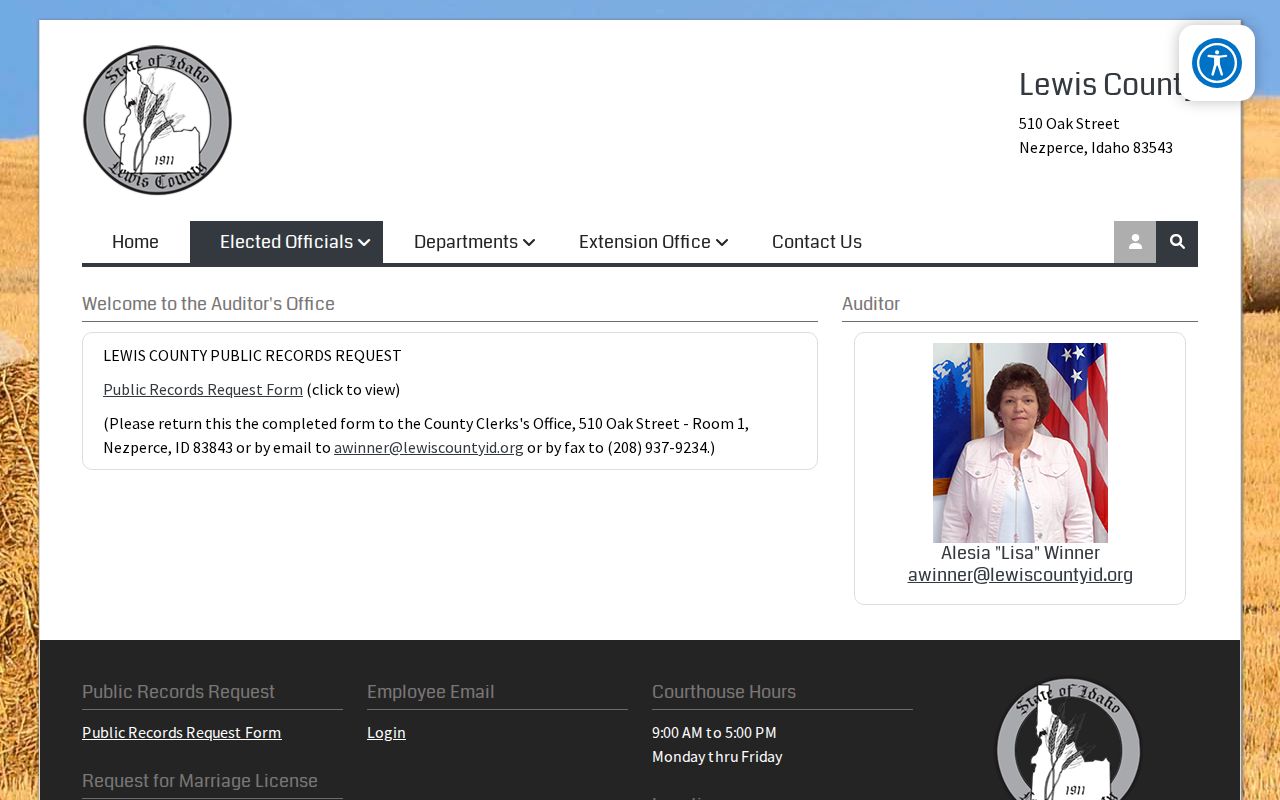
The Lewis County Clerk, Auditor, and Recorder sits at 510 Oak Street, Room 1, in Nezperce, reachable at 208-937-2661. The county page links a public-record request form. Current courthouse sources use ZIP 83543, while an older Auditor page showed 83843, so confirm the mailing ZIP before mailing a paper request. Direct requests there rather than expecting a searchable deed index online. The official Auditor and Recorder page lays out the county's public request route.
Prepare before contacting the Recorder. A precise deed request gets results faster than a vague one. Have the parcel number ready. Include current and former owner name spellings, plus the lead line of the legal description. Add the instrument type. Also include an approximate recording date window and any book, page, or document number you already hold. Say plainly what you want. Choices are inspecting the record, an uncertified copy, or a certified copy. The county publishes no set copy or certification fee schedule. Ask about charges and staff search time when you order.
Counter or vault access in person can settle a poor scan or an index ambiguity. A quick phone call confirms the right request wording. For older clues, FamilySearch, the State Archives, library newspapers, and city files form the fallback chain. The Recorder stays the source for county-certified land instruments.
Depth of Lewis County Ownership Records
Lewis County ownership records run deep. The historic deed lead reaches 1868–1911. Homestead declarations span 1895–1964. Probate estate registers cover 1911–1940. Those ranges describe catalog titles, not a promise that every image is open online. Current books remain questions to ask with any request. Certification charges, archive transfers, and the recorder imaging cutover belong on that same list.
Lewis County records show no courthouse fire, flood, lost book, or reconstructed volume. Do not explain a gap with a disaster story. Confirm one with the Clerk or Archives first. When a chain stalls, ask about spelling variants and adjacent book ranges. Plats, surveys, probate, and predecessor jurisdictions can also break the stall.
Lawful use. Research former owners for house history, estate work, purchase diligence, and title questions. Never use public names or addresses to stalk, harass, or harm anyone.