
Lewis County Property Value Types
Recorded figures each do a different job. Idaho law directs assessors to value property at 100 percent of market value before exemptions. That figure is administrative, not a promise. It supports property taxation, not a sale. The latest conveyance in the deed records may list consideration, though the Lewis County parcel popup does not display a verified last-sale amount. A licensed appraisal stands apart as a professional opinion tied to a stated date and purpose.
| Value | What It Is | Where |
|---|---|---|
| Assessed value | The county value used within Idaho's property-tax system | Lewis County Assessor records |
| Market-value estimate | The assessor's mass-appraisal estimate before exemptions | Assessment record and Idaho Tax Commission guidance |
| Last sale price | The consideration paid in one transfer, when the recorded instrument states it | Lewis County Clerk/Auditor/Recorder |
| Private appraised value | A professional opinion for a particular property, purpose, and date | Licensed appraisal, not the public tax roll |
A sale price reflects one deal and one date. An assessed value does not. It grows from a countywide process. The assessor may weigh property classes, physical traits, and market evidence across many parcels. Idaho ratio studies compare assessments with market or sale evidence to check level and uniformity, but they never turn a tax value into an expected sale amount.
Idaho's Full-Value Assessment Standard
Idaho's Tax Commission assesses property at 100 percent of market value before exemptions. Market value here means the assessor's estimate of what a property would generally bring in an open market. It exists for tax administration. Always pair the figure with its year and property description. Land use changes, new improvements, parcel splits, and market movement can all shift the next assessment. Land use changes can matter on their own. So can market movement.
Ratio studies work differently. They compare assessments against sale or market evidence. That tests whether a county's work sits at the required level and stays reasonably uniform. A ratio is an oversight measure. It is not a parcel appraisal. It cannot promise that a given home, farm, timber tract, or commercial site will sell at the countywide ratio. No single parcel follows the ratio exactly.
Find a Lewis County Assessment
The Lewis County Assessor page links the public parcel experience and supports searches by street address, owner name, parcel number, or latitude and longitude. Start with the address. Save the parcel ID the map returns. Rural roads, city and ZIP quirks, or parcel split history can make the parcel number the better search key.
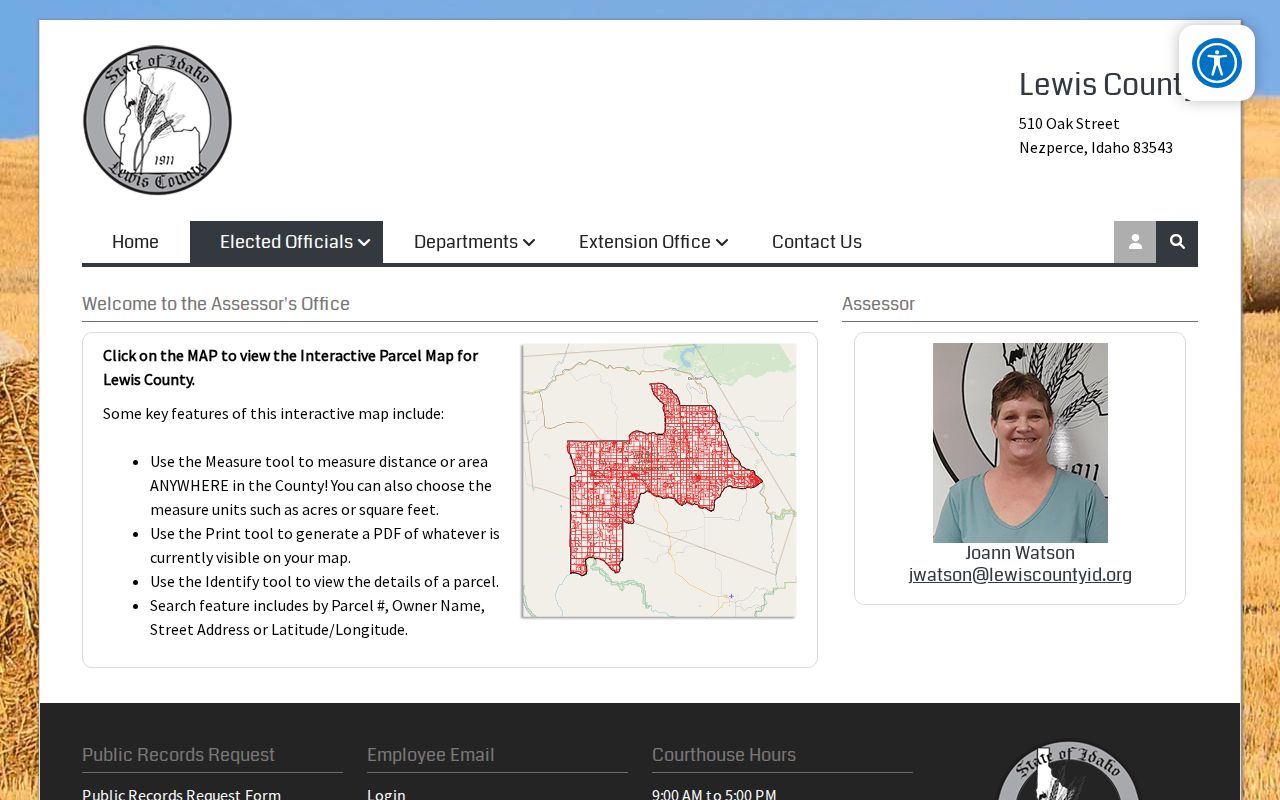
The official county page is the right starting route. Follow its link into the parcel experience. Keep the value and assessment year beside the correct parcel ID. The underlying layer carries owner of record, parcel, description, acreage, mailing or situs fields, property-class data, and taxing-district details. One improvement-related label appears truncated. Its full public meaning is not displayed in the public result. Never expand a shortened label by guesswork. When an assessed-value field or assessment year is unclear, contact the Assessor for the authoritative figure.
Check Lewis County Property Values
A careful lookup keeps value, year, and parcel together. It also separates assessment evidence from a transaction price. Follow this sequence when you compare a Lewis County property value against other sources:
- Search the address in the Lewis County Assessor Interactive Parcel Map and confirm the parcel ID.
- Record the assessment value and year exactly as the Assessor provides them.
- Note any property-class, acreage, land, improvement, or exemption information that is actually shown.
- Request the latest deed from the Clerk/Auditor/Recorder if a recorded sale or consideration amount is needed.
- Compare only records from similar dates and definitions.
- Assessed value
- The value established by the county assessor for property-tax administration.
- Market value
- The estimated open-market value underlying Idaho's full-value assessment standard.
- Sale or consideration price
- The amount attached to a specific transfer when the recorded instrument discloses it.
- Assessment level
- The relationship between assessed and market value reviewed through ratio studies.
- Reassessment
- A later review that updates a parcel's valuation for a new assessment period.
Lewis County's 2025 Value Mix
The Idaho Tax Commission's 2025 table breaks Lewis County assessed value into classes before the homeowner exemption. Residential property totals $218,393,663. Agriculture adds $143,858,232. Commercial comes in at $77,975,762, utilities at $12,118,728, and timber at $4,862,250. Mining is listed at zero. The combined total reaches $457,208,635.
These are countywide tax-value totals, not sale volume or an average parcel price. A farm, timber tract, utility parcel, storefront, and residence sit in different classes, so comparing unlike parcels misleads; treat the totals as county context only.
City Values Need Careful Comparisons
A 2022 state table lists municipal assessed-value totals of $75,320,977 for Kamiah, $27,879,464 for Craigmont, and $25,523,920 for Nezperce. Kamiah carries the largest total of the three. That ranking says less than it seems. Each figure aggregates all taxable city value. The totals cannot establish a price per parcel, a stronger market, or a current standing for any of the three cities.
Municipal lines and postal labels create their own trap. Kamiah has a cross-county community context, so a Kamiah mailing address may not identify a Lewis County parcel by itself. Confirm the parcel geometry and county before using a city total as context for one property.
Exemptions Change Taxable Value
An exemption can shrink the value subject to tax without rewriting the property's market evidence. It leaves a prior sale price untouched too. Idaho's homeowner exemption hinges on qualifying primary-residence conditions. The Assessor administers exemption status. The Treasurer then applies the resulting tax information to billing. A lower taxable figure signals no weaker market.
Compare figures with care. Before weighing two Lewis County valuations, confirm whether each number is a gross assessment, a post-exemption figure, or a tax-bill amount. Keep exemption questions with the Assessor, and see the Lewis County property tax records resource for bills, due dates, payment, and appeals.
Sale Price Lives Elsewhere
Lewis County's public parcel popup lists no last-sale date or sale price. It also shows no transfer-tax figure, deed book and page, or recorded instrument number. A sale-price search therefore starts with the parcel number and the owner of record. It then moves to the Clerk/Auditor/Recorder. The county publishes no public grantor-grantee index. Requests go through the county form, by phone or mail, or at the courthouse counter.
A deed's stated consideration still needs context. Transfers among relatives, estates, trusts, or related entities do not always reflect an open-market deal. A quiet-title judgment, partition, sheriff's deed, or probate transfer can also change ownership without a typical sale. iCourt may offer case clues. But the recorded instrument remains the county property-records lead.
Map Dates Are Not Value Years
ArcGIS metadata lists August 8, 2025. It is a modification date for the Lewis County Parcels web experience. That is simply an application update. It proves nothing about the assessment year. It also proves nothing about the parcel refresh date, or a transaction date on any selected record. The county publishes no historical roll range or fixed refresh schedule.
So ask the office directly. Capture whatever year the Assessor displays, and question the office when no year appears. A saved map PDF documents what the screen showed. It cannot convert a portal timestamp into an assessment date. The distinction matters. An appraisal, a recent sale, and a tax figure can come from different periods.
Questioning a Lewis County Value
Start with the Lewis County Assessor when parcel facts or an assessed value look wrong. Bring the parcel ID and the assessment notice. Bring photos and sale evidence. Add documents showing a factual error. Idaho allows the process to continue to the county Board of Equalization. State guidance ties the appeal calendar to the fourth Monday in June. The deadlines on the current notice control.
Remember that an appeal challenges the assessment, not the tax payment record. Court review may follow the authorized process. Public case information may appear in Idaho iCourt. Actual court documents route through the Lewis County courthouse kiosk. They may also route through the clerk, subject to court access rules. Tax bill and payment mechanics belong with the Treasurer.
Limits of Lewis County Property Values
An assessor values the whole tax base at once. The result is not a property-specific inspection. It is not prepared for a purchase, estate, financing, insurance, or dispute. It may also differ from a sale completed after the valuation date. Treat the GIS polygon and acreage as reference data, not a boundary survey. Neither one predicts how a buyer will price access, condition, water rights, easements, or improvements.
Value is not price. A Lewis County assessed value supports taxation and does not predict a sale price. Obtain a licensed appraisal when a property-specific market opinion is required.