
Lewis County Tax Record Fields
Lewis County property tax records pull from two different offices. The Assessor sets taxable value and tracks exemption status. The Treasurer mails the notices and records each payment as it arrives. Together they cover the full tax picture. The public parcel popup only adds parcel and district context, though. Treat it as a starting point, not a complete tax account.
| Field | What It Shows | Where |
|---|---|---|
| Assessed value | Market assessment used in taxation | Assessor |
| Taxable value | Value after eligible exemptions | Assessor |
| Exemptions | Relief tied to state eligibility | Assessor |
| Bill and status | Amount, installments, payment, or delinquency | Treasurer |
| Taxing districts | City, fire, highway, library, school, and S&W | Parcel popup |
Idaho assesses property at full market value before exemptions apply. That figure is an administrative estimate, not a promised sale price. The map popup shows no verified sale-price field either.
Lewis County Tax Offices
The Lewis County Assessor handles the roll, valuation, parcel class, and exemptions. The Lewis County Treasurer handles notices, payment, late balances, and tax-deed status. Call 208-937-2320 for assessment facts and 208-937-2341 for bills.
No public historical tax-roll search was located. Older rolls may require a county request or Idaho State Archives research. A payment arrangement changes timing, not assessed value.
Lewis County 2025 Values
The 2025 Idaho county-class report puts Lewis County residential value at $218,393,663, commercial at $77,975,762, and agriculture at $143,858,232. Timber comes in at $4,862,250, and utilities at $12,118,728. Mining sits at zero. The countywide total comes to $457,208,635 before the homeowner exemption. Treat these as assessment totals rather than sales or individual appraisals. They show why land class matters when you compare parcels.
Lewis County Tax Definitions
Assessed value is what lands on the roll. Taxable value subtracts exemptions. A levy is the rate a taxing district applies, and a tax lien is the legal claim behind unpaid tax. Ratio studies test uniformity by weighing assessments against sale evidence.
Keep the numbers separate: assessed value supports taxation, a recorded consideration may reflect a transfer, and an appraisal answers a different valuation question.
Lewis County Exemption Records
The Idaho homeowner exemption covers a qualifying owner-occupied primary residence plus up to one acre. Other reduction programs follow separate tests and yearly instructions. An exemption lowers taxable value only. It never changes parcel size or title.
Ask the Assessor which exemption appears on the current roll and which form applies. Follow the current-year state instructions, since income limits and deadlines shift from year to year.
Look Up a Lewis County Bill
Begin with an address in the county parcel map. Jot down the parcel number, displayed owner, and taxing districts, then ask the Treasurer for a bill number if you lack one. Paying online takes the bill number, the tax year, and the amount due.
- Find the parcel and full ID.
- Confirm the current tax year.
- Get the bill number from the notice or Treasurer.
- Review installments, payments, and balance.
- Keep the receipt with the parcel record.
- Assessed value
- The roll value before eligible relief.
- Levy
- The taxing-district rate.
- Homeowner exemption
- Qualified primary-residence relief.
- Tax lien
- A claim securing unpaid tax.
Lewis County Payment Calendar
Notices go out in November. Full payment or the first half falls due December 20, and the second half on June 20 of the following year. Postmarks count, and the bill stub should ride along with payment. Receiving a bill does not mean an escrow plan failed.
Miss the first half and a 2 percent late charge applies until January 1, after which interest runs 1 percent monthly. Once June 20 passes, the second half draws a 2 percent late charge plus interest back to January 1. Never getting the bill does not excuse these charges.
An online e-check costs $1 per transaction. Cards cost 2.5 percent through the vendor. Card payments work by phone, but e-checks do not.
Lewis County Tax-Deed Status
The official tax-deed page lists no sales scheduled at present. That is a current status statement, not proof that no delinquency exists or that no sale will be held later.
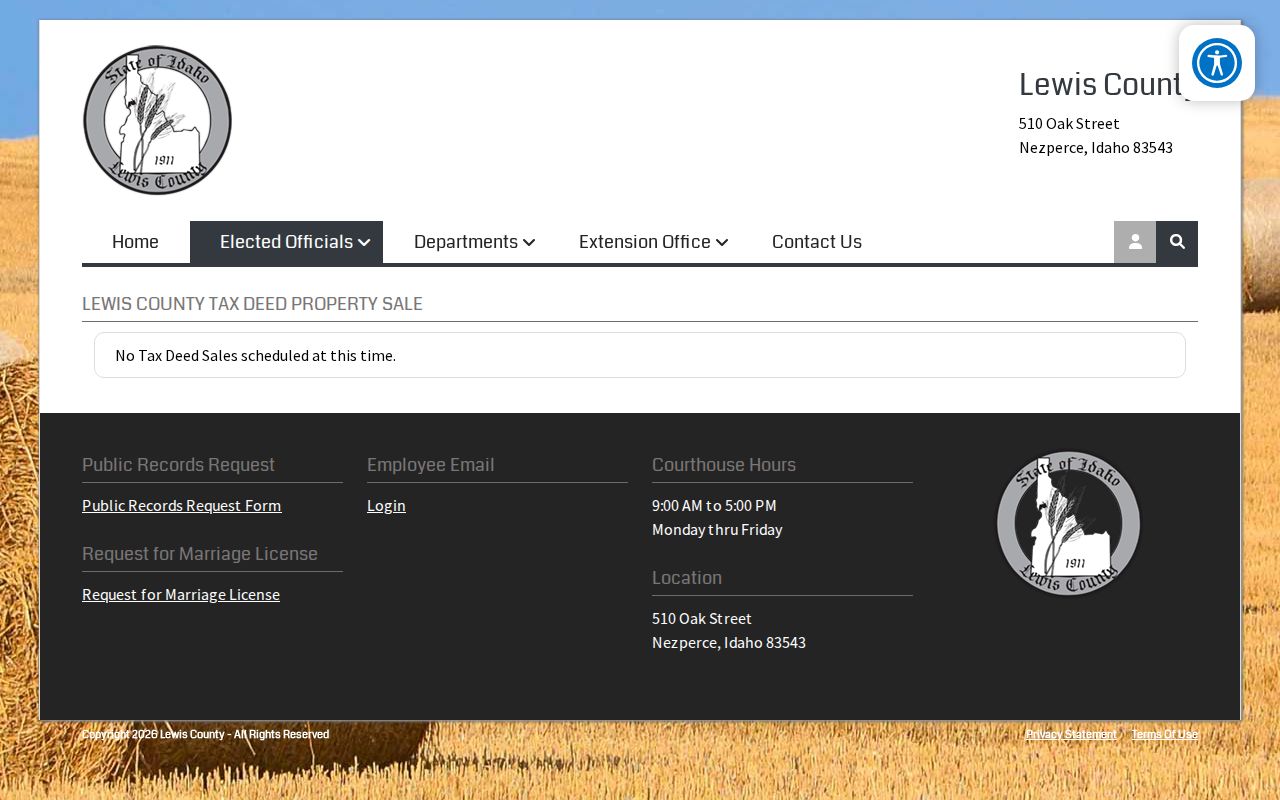
The county publishes no public delinquency, redemption, sheriff-sale, or tax-lien list. Contact the Treasurer for current status, and check the Recorder once a tax deed is issued.
Contest a Lewis County Assessment
Start with the Assessor. Compare the parcel description, class, acreage, and value against solid evidence. Idaho appeals run from the county Board of Equalization to the State Board of Tax Appeals or district court as applicable. Deadlines track the assessment notice and the annual calendar.
Appeal window. Contact the Assessor when the notice arrives and confirm the current Board of Equalization filing deadline and required form.
Start with the assessment notice itself. Add the parcel number, photos, measurements, and any sales evidence you can gather. Documents showing a factual error belong in the packet too. The Assessor publishes each figure. For a plain-language explanation, see Lewis County property values.
An appeal and a tax payment run on separate tracks. Filing one does not pause a Treasurer deadline or suspend a bill. Keep paying while the value is under review. Idaho Code §63-902 says nonreceipt of a notice never excuses late charges or interest. So hold onto proof of every payment and of the appeal filing itself.
Idaho Code §63-906 opens an installment route through the tax collector. Each payment must be at least $25. Otherwise it must cover the remaining balance. Interim receipts earn no interest, and deposited funds cannot be withdrawn. The arrangement shifts payment timing only. It changes no parcel fact, exemption, or assessed value.
Lewis County publishes no public historical tax-roll database. Ask the Assessor for prior roll fields instead. The Treasurer holds past bill and payment material. The Idaho State Archives retains older county tax collections. Give each office the parcel ID and the owner name used that year. Add a legal-description clue and a narrow date range. Old parcel numbers deserve saving after any split or merger.
Tax-deed questions can cross several custodians. The Treasurer establishes delinquency and sale status. The Recorder holds any later tax deed. A court file may hold a challenge to one. The county's own page reports whether sales are scheduled. That answer changes, so recheck the official page and call 208-937-2341.
Taxing districts explain a lot. Two Lewis County parcels with similar assessed values can carry different bills because of them. The public popup labels the Tax Code Area. It also lists City, Fire, Highway, Library, School, and S&W districts. Those fields describe the parcel's public taxing geography. They prove neither that every displayed rate is current nor any title encumbrance. The Treasurer can compute the actual bill for the exact parcel and year.
For mail payments, use the bill stub and follow the county's postmark rule. Online, enter the bill number, tax year, and amount from the current notice. Save the vendor confirmation with its receipt number, date, amount, and parcel file. Call the Treasurer if the two balances disagree.
Reconcile a Lewis County Tax Account
Match the parcel before anything else. Compare the situs address and the displayed owner. Check the acreage and the taxing districts too. Then use the exact parcel ID with the Treasurer, since the payment vendor accepts known bill details but is not a delinquency or historical-roll database. Ask the office to confirm the tax year, installment status, credited payments, balance, late charges, and any formal collection step.
A notice can go to a taxpayer or agent even when a mortgage company is involved. That alone does not prove an escrow servicer failed to act. A mailing address is a destination, not occupancy proof. Keep the bill stub, receipt, postmark evidence, and written account explanation in one file.
Idaho Code §63-906 sets the installment mechanism. Payments run at least $25 or the remaining balance. Interim receipts earn no interest, and the deposit cannot be withdrawn. Only the timing changes. Assessed value is untouched, and valuation questions still go to the Assessor and the appeal process.
Read Lewis County Tax Districts
The parcel popup labels each district. Tax Code Area, City, Fire, Highway, Library, School, and S&W context all appear there. Those labels explain why nearby parcels get different notices. The county summary names city districts for Craigmont, Kamiah, Nezperce, Reubens, and Winchester, plus school, cemetery, and Prairie River Library districts.
An overlay is not a lien. It is not a surveyed line either, so a wrong-looking assignment deserves a question to the Assessor about which roll fact controls. If a charge is unclear, ask the Treasurer to identify the levy components on the actual bill. Keep that apart from a market-value appeal.
Separate Lewis County Tax Questions
Value and bill questions need different evidence. For value, gather the assessment notice, parcel class, acreage, and land and improvement facts the Assessor can verify. Exemption status matters too. For the bill, get the tax year, bill number, levy detail, installment dates, credited payments, balance, and delinquency information from the Treasurer. A receipt cannot fix a parcel fact. An appeal cannot replace a missed-payment inquiry.
The homeowner exemption covers a qualifying owner-occupied primary residence and up to one acre under Idaho guidance. Property Tax Reduction has its own annual eligibility rules. Ask which program appears on the roll and use the current application. Never infer exemption status from a mailing address. The public compact parcel popup shows no verified exemption field either.
For an appeal, set the Assessor's record beside accurate measurements, photographs, classification facts, and market evidence. Contact the office as soon as the notice arrives. The Board of Equalization calendar controls the filing window. Keep the appeal record apart from Treasurer payment arrangements, late-charge questions, and tax-deed inquiries. Each process has its own custodian and deadline.